
Peter Mullan, LC
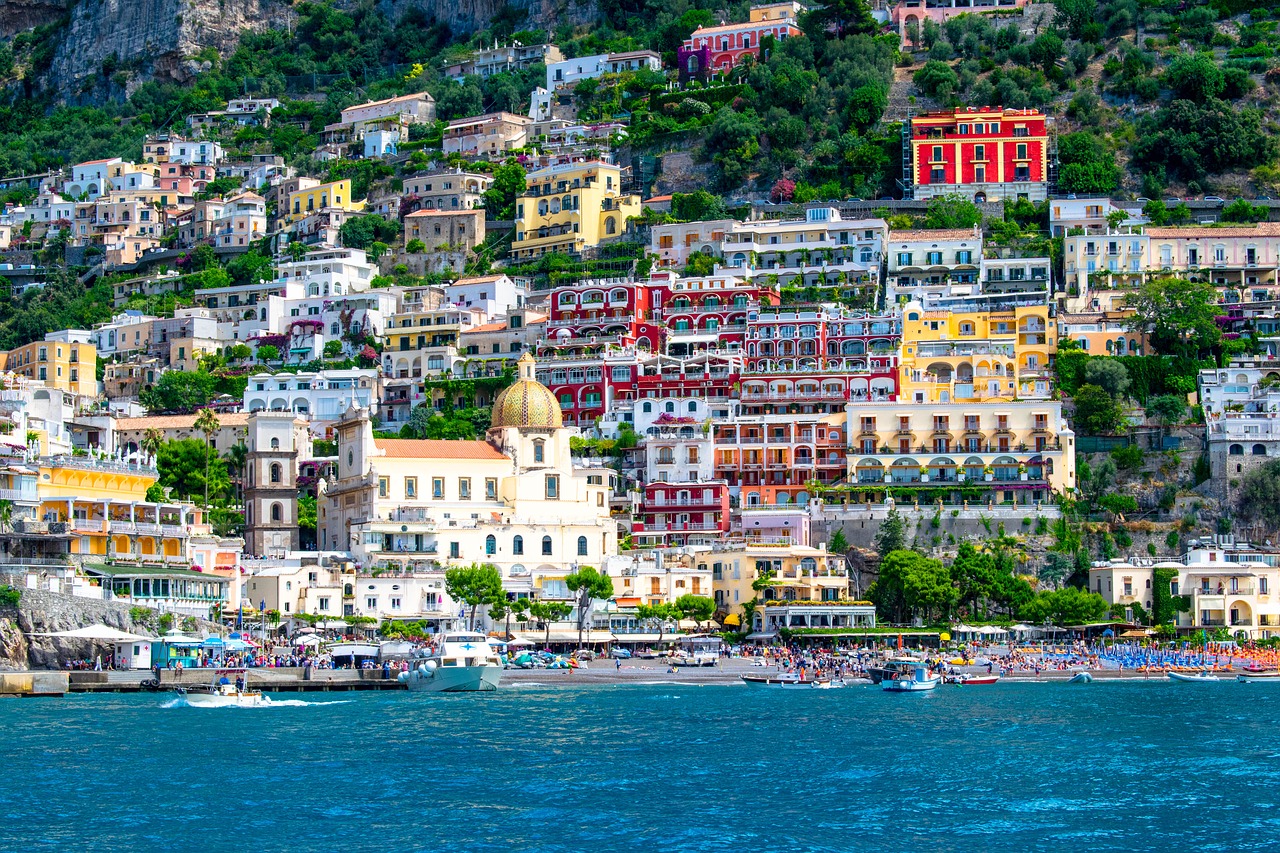
Of all the places in the world I know, Positano, Italy, stands apart for me with its breathtaking views of mountain and Mediterranean. South of Naples, nestled among the Amalfi coast cliffs, I first visited there in August 2004. The Legionaries of Christ have a summer vacation center about 12 miles away from Positano, and I hiked there on several occasions. But it wasn’t until Easter 2012 that I discovered Positano’s hidden treasure. The local pastor would have Legionaries come every Easter break to bless the homes there, along with the restaurants and hotels, Positano being a tourist heaven. In 2012 they “happened” to ask me to be in charge of the eight seminarians that Easter week. In Positano’s Mediterranean/mountain paradise, I experienced for the first time God’s goodness. Obviously, God’s love was a familiar concept for me: Raised in a strong Catholic family, I had already lived through 15 years of Legionary formation by that point. For several reasons that I will spare you the boredom of reading, I had come to a rather pharisaical relationship with the Lord. Just like the Pharisees in the Gospels, I had reduced my approach to God as fulfilling my part of the deal by checking off all the daily, weekly, monthly, etc., duties I’d be assigned. I’m consoled by the fact that “pharisaical” is a common term in religious circles; quite a common phenomenon among those who dedicate themselves fully to the faith. But I’m even more consoled by the fact that the Lord brought me to Positano to show me that he doesn’t need nor asks for my task list: He simply loves me and all his children. Both the natural beauty of Positano and my blessing people and their homes and workplaces opened up my eyes to God’s fundamental goodness.
Positano is aptly dedicated to the protection of la Madonna di Positano, a 12th century icon of Our Lady enthroned with her child Jesus. And even more aptly, they celebrate August 15th as her feast day, which is the Catholic Church’s celebration of the Assumption of Our Lady to heaven. It being southern Italy, it is a 36 hour ordeal: Mass and procession by boat on the eve before the 15th, then a solemn Mass and street procession all afternoon on the actual feast day, wrapped up with a midnight firework display. Why all the fuss? It is in honor of the unique, one-of-a-kind fact that Mary, the mother of Jesus, has been assumed body and soul to heaven. Besides her Son, the Risen Lord, Mary is the only other human being who already enjoys heaven in her human, albeit glorified body. The saints all certainly enjoy heaven already, but only as their spiritual souls; they, like ourselves, await the resurrection of our bodies at the end of time. I know that can be quite a mouthful to chew and swallow the first time you come across this particular piece of Catholic dogma. Before we start to mull it over, a quick link back to Positano: To copy and slightly adapt the poetic phrase at the city entrance to neighboring Amalfi, “for Positanians, the day they enter Paradise will be a day just like any other: they already possess Paradise here at home in Positano.” Positano is a natural, topological reminder of that mystery we Catholics celebrate at Mary’s assumption: We are all called to heaven, not just for a few days’ vacation, but forever, for time without end, body and soul together.
In August 2020, as I was wrapping up my doctoral studies in Barcelona, Spain, I had the privilege to walk the Camino de Santiago as chaplain for a group of 50 Spanish young people. After bringing another two groups from Mexico on the Camino, I have begun – only just barely – to fathom the impact the 70+ mile walk has on us humans. As the days, miles, and beautiful countryside go by, the Camino stirs something deep within. Like all things human, that “something” is richly complex. But one essential factor of the Camino experience is that sense of direction: Where am I headed? Why exactly do I endure the aches, the pain, the blisters, the rain, etc.? The goal or destination truly becomes transcendental on the Camino, if all the difficulties involved are to become bearable and meaningful.
Now, I understand people walk to Santiago for very different reasons: The Catholic sense of pilgrimage to the tomb of the Apostle James might not be exactly the top motive for most Camino walkers. Whatever the motive, the Camino does speak deeply to all its transients, precisely because it faces them with that life-changing question: Where am I heading? And that is where the assumption of Mary comes in: God brought her to heaven as a sort of guarantee on his promise that we all will be raised on the last day. “So what?,” you rightfully ask, “big deal, hurray for Mary; what is in it for us?” What the assumption does for us is set the final destination as firmly and clearly as we could possibly hope for. And once the goal of our existence is clear, what path / choice to take becomes much clearer. Our life becomes like the Camino, with heaven as the final destination. More than heaven as a place, the sense-giving goal is a Person, a Communion of Persons so deeply in love that we can hardly imagine it. Just how important this Marian dogma is for our everyday lives begins to dawn on the believer.
J. Peterson has become ever more vocal about the importance of meaning for a healthy human psychology. He puts the inquiry to today’s culture, why such a widespread, quite frightening outbreak of psycho-emotional maladies today? If the modern era’s concept and promise of material and technical progress were all it made itself out to be, then affluent countries in North America and Europe should be the happiest countries in all of human history. Since such is rather plainly not the case – I’ll leave the stats search to ChatGPT–, might faith and religion float back to the surface of human awareness, to the chagrin of many a materialist, practical atheist? Now that I’ve begun to teach undergraduate Western civilization, the turn away from all things Christian becomes more and more apparent. As Europe became more affluent, knowledgeable, and tech-savvy, faith in Jesus Christ became that much more superfluous, on the surface at least. To use the example of adolescence and young adulthood, humanity came of age around the 15th and 16th centuries, and rebelled hard against all authority, moral boundaries, and God. And like a drunk and high teenager after ramming his car into a tree, what did we learn after Auschwitz, the Soviet gulags, and the Lehman Brothers? I certainly don’t hope to reform humanity with this piece; take it more as soul-searching and reflection about how we got here. If the formula for happiness without the God factor seems to have dead-ended (although, we being humans, we will very likely end up crashed into another tree fairly soon, both individually and collectively), what if we draw God back into the equation?
As the post-COVID world scans the numerous paths forward, a renewal in our sense of faith, of openness to the Other, would go a long way in brightening up all those paths. In that vein, the seemingly medieval naivete behind the assumption of Mary takes on a much more personal clout. Who exactly is Mary of Nazareth? Quite a challenging question, one that I am no theologian to attempt to answer fully. For me, Mary is God’s prototype for humanity: While being just like you and me, Mary is the first of our race to collaborate fully and unconditionally with God’s grace in her life. She is his masterpiece, not as an art piece to be guarded exclusively in some royal gallery, but placed openly as our goal, standard, and prototype. Perhaps precisely because she is so special, we very easily write her off as an anomaly, completely aloof from our mundane, all-too-self-centered existence. However, she was hardly the sheltered, privileged maiden we’d expect: Mary’s faith was constantly and painfully put to the test throughout her entire life. She too had to pilgrim in the chiaroscuro of human faith in the Lord, with no clear answers for her immediate future. Which then makes her assumption to heaven that much more meaningful: That historical event is God’s promise to all who put their faith and trust in him – his way, his plan, his moral standards, his journeys through the desert of human suffering –: He truly will reward them in the next life, with life in abundance.
What exactly does that faith imply? How does it become manifest, concrete in my life? That, in part, will be the subject I hope to address little by little in this series of writings. I personally believe that Christian faith and life go hand in hand quite aptly, even if that faith sometimes tugs us forward rather painfully. Human existence and life is a marvelous adventure, full of innumerable and ineffable obstacles to overcome; believers in the Incarnate God have an entire armament within their reach. My wish is that with these personal reflections we may discover and experience the full potential of faith lived out in all its dimensions. May Mary guide us along the path of an ever more conscious faith, destined towards the only goal worth a human life: God, glorious God.